Zoning in on Growth: How Oregon’s New Housing Legislation is Unlocking Multifamily Potential
If you want to understand where the real estate market is heading, you have to look at policy. For decades, the West Coast has struggled with a deep, systemic housing supply shortage. High land costs, restrictive zoning laws, and complex local approval processes combined to make high-density development incredibly difficult to execute.
However, the tide is turning. Oregon’s legislative sessions have ushered in a series of sweeping zoning and land-use reforms specifically aimed at jumpstarting the construction of middle housing and multifamily developments. For real estate investors, these regulatory shifts represent an unprecedented opportunity to unlock value in regions that were previously locked down by single-family mandates.
Breaking Down the Key 2026 Legislative Shifts
The state’s focus is clear: break down the barriers to density while providing tools to make financing and building multi-unit properties more achievable. Let’s look at a few of the most influential changes shaping the industry right now:
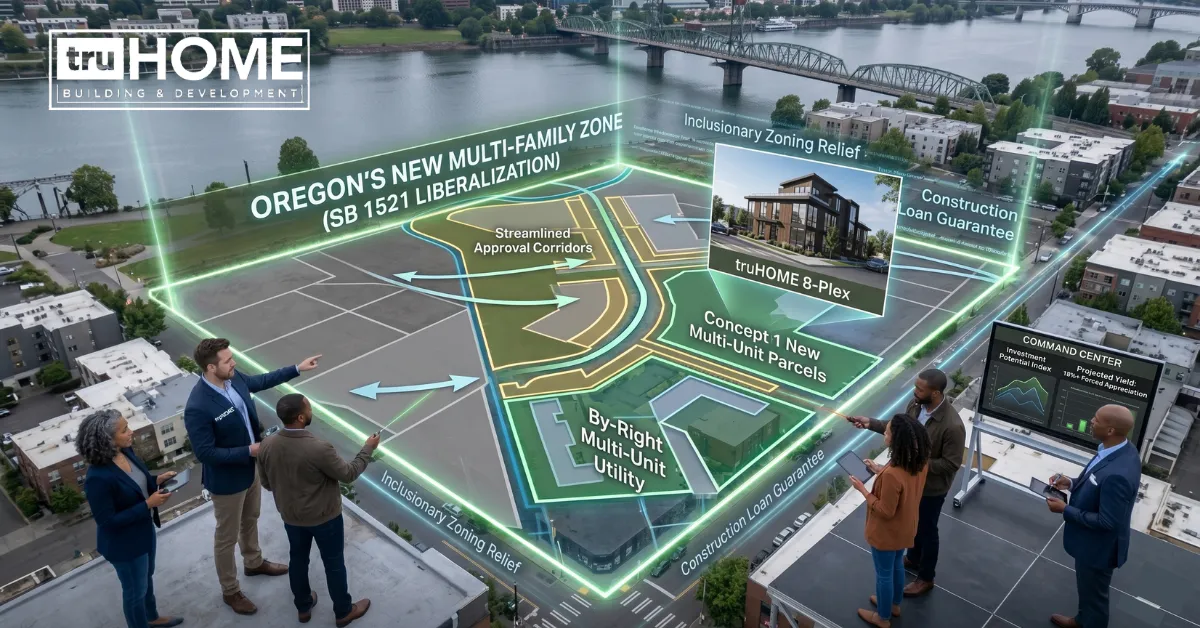
Zoning Liberalization & Middle Housing Expansion: Building on previous foundations, Oregon has expanded statewide land-use reforms. These rules essentially make it easier to construct duplexes, triplexes, and courtyard apartments in zones that traditionally restricted development to single detached homes. This allows developers to dramatically boost the utility of smaller, urban, and suburban infill lots.
SB 1521 (Inclusionary Zoning Relief): In major metro areas like Portland, new regulations prohibit local governments from enforcing aggressive affordable housing mandates on developers unless they actively offset those financial losses. This effectively softens rigid inclusionary zoning rules, making private market-rate developments financially viable once again.
The Construction Loan Guarantee Program: Managed by Oregon Housing and Community Services (OHCS), this state-backed program provides a $20 million pool to backstop construction loans for qualified projects. In an era of tighter banking liquidity, this gives private lenders the peace of mind to fund projects, easing the path for developers to secure essential financing.
What This Means for Your Investment Strategy
Before these reforms, if you wanted to build an 8-plex or a modern townhome community, you often faced years of public hearings, conditional-use permitting, and neighborhood opposition.
Today, the path toward high-density development is increasingly streamlined. Investors can acquire well-located, underutilized single-family lots, level the outdated structures, and build beautiful, cash-flowing multifamily units with vastly reduced regulatory friction.
By increasing the number of doors on a single parcel of land, you split your fixed land costs across multiple revenue streams. If you purchase a lot and build one single-family home, your financial upside is bound to that one asset. If you use Oregon's modern zoning landscape to place a multi-unit complex on that same lot, your revenue potential scales exponentially.
Navigating the Local Micro-Markets
While state laws provide the framework, executing successfully requires deep local expertise. Cities like Salem, Medford, and various growing exurban corridors are adapting to these rules at different speeds. Success relies on identifying the exact pockets where demand for rental housing overlaps with favorable municipal infrastructure.
The regulatory gates have opened. The only question left is which investors will move quickly enough to build through them.
Want to capitalize on Oregon's shifting land laws? We specialize in identifying and building high-yield middle housing and multi-family assets. Explore our interactive development maps and start your planning at www.oregonmultiplex.com.