The 2026 Energy Shift: Why "Green" is Now a Line Item on Your P&L
For years, "green building" was often viewed by investors as a luxury—a nice-to-have feature that added a marketing sheen to a property but usually came at the expense of the initial margin.
As of 2026, that paradigm has officially shifted.
With the full implementation of Oregon’s latest building codes and the tightening of federal energy standards, sustainability has moved from the marketing department to the balance sheet. In today's market, energy efficiency isn't just about "doing good"; it’s about protecting your Net Operating Income (NOI) and ensuring your asset doesn't become a "compliance liability" before it even hits its five-year anniversary.
1. The Death of "Compliance Drag"
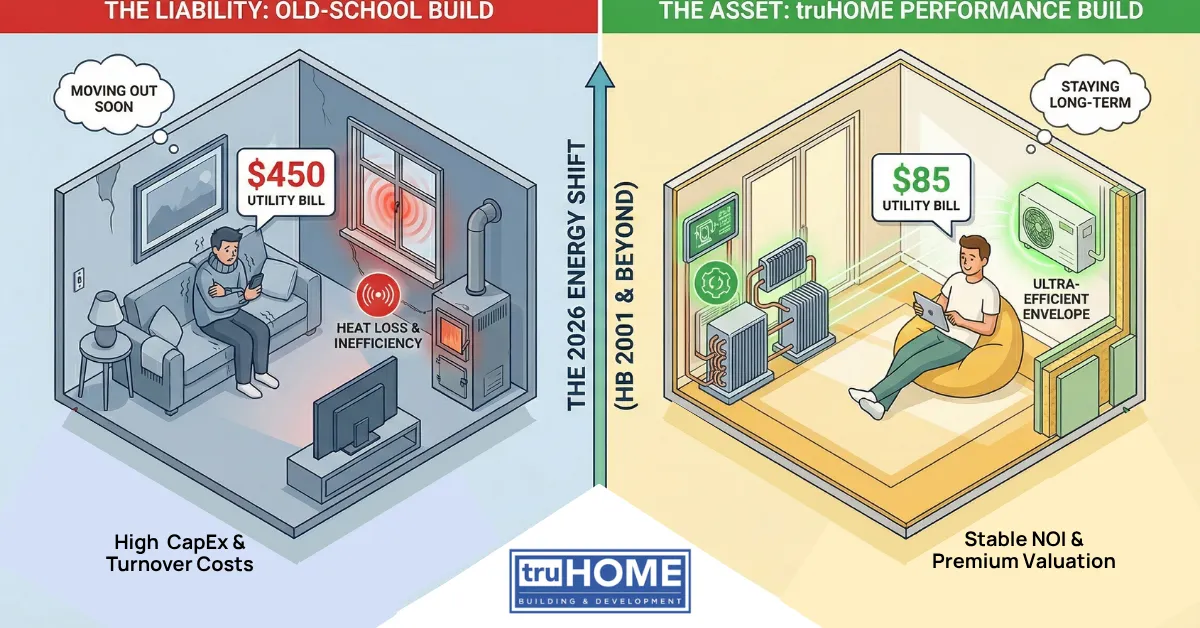
Many developers are still building to yesterday’s standards, a phenomenon we call Compliance Drag. When you invest in a property that barely skims the minimum requirements of the 2026 Oregon code, you are essentially buying a building that is already on its way to being obsolete.
As municipalities move toward stricter carbon-neutral mandates, older or poorly built properties will face expensive retrofitting requirements. By building with truHOME, you are investing in a "future-proof" asset. We prioritize high-performance envelopes and superior insulation today so you aren't paying for upgrades tomorrow.
2. Reducing Tenant Turnover via "Utility Stability"
One of the most overlooked "leaks" in an investor's P&L is turnover caused by utility spikes. In the current economic climate, tenants are hyper-aware of their total cost of living.
A "cheap" build with a traditional HVAC system and standard windows often results in:
The Winter Exodus: Tenants leaving after being hit with $300+ heating bills.
The Summer Surcharge: High cooling costs that make the rent feel $200 more expensive than it actually is.
Our use of ultra-high-efficiency heat pump systems and advanced thermal bridging techniques creates a stable indoor climate. When a tenant's utility bill stays low and predictable, their "rent-to-income" ratio remains healthy, and they stay in your unit longer.
3. Commanding Premium Market Rents
The modern tenant in 2026 is more educated than ever. They are looking for features like improved indoor air quality (IAQ), smart thermostats, and LEED-adjacent certifications.
Data shows that "High-Performance" rentals in Southern Oregon are currently commanding a 10-15% rent premium over standard builds. Tenants are willing to pay more for a home that feels premium and saves them money on the back end. For the investor, this translates directly to a higher yield and a faster path to recouping capital.
4. Lowering Long-Term Maintenance Costs
Sustainability is often a proxy for quality. A high-efficiency heat pump doesn’t just save energy; it’s a more sophisticated, longer-lasting piece of equipment than a bottom-barrel furnace.
When we build with "Green" in mind, we use materials that are designed for durability:
Moisture-managed building wraps that prevent rot and mold.
Inductive or high-efficiency appliances with lower failure rates.
LED integrated lighting that eliminates the constant cycle of bulb replacement.
The Bottom Line for Investors
In 2026, the gap between "Premium Assets" and "Discount Assets" is widening. A property that isn't energy-efficient is a property that will eventually require more capital expenditure (CapEx) to remain competitive.
At truHOME Building and Development, we don't look at energy codes as a hurdle to clear. We look at them as a blueprint for building wealth. We ensure that every dollar spent on efficiency is a dollar that works to increase your property's value and your annual cash flow.
Don’t buy a liability. Invest in a future-proof asset.
Ready to see the numbers? Contact truHOME today for a detailed breakdown of our current 2026 builds and how our energy-forward approach maximizes your ROI.