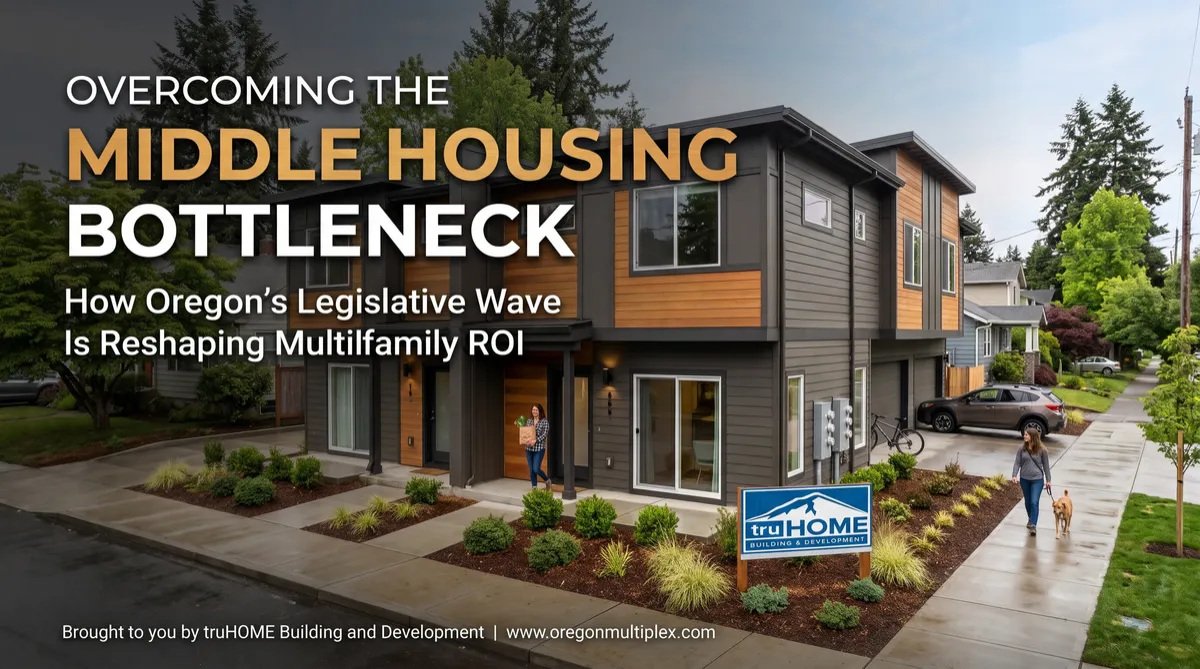
Overcoming the Middle Housing Bottleneck: How Oregon’s Legislative Wave Is Reshaping Multifamily ROI
The traditional playbooks of residential real estate investing have collided with a hard reality: suburban single-family detached homes are yielding historically compressed cap rates, while conventional 50+ unit commercial apartment complexes face high capital hurdles, elevated debt costs, and lengthy municipal discretionary reviews. Between those two extremes lies the most lucrative, policy-favored asset class of the decade: missing middle housing.
For investors navigating the Pacific Northwest, Oregon has positioned itself as the nation’s premier incubator for urban density reform. Landmark measures like House Bill 2001 dismantled single-family zoning, but subsequent municipal interpretations often created bureaucratic friction. Today, recent statutory updates—spearheaded by bills like HB 4037, section adjustments clarifying objective development standards, and Senate Bill 458 land-division expansions—are fundamentally altering the risk profile of building 2- to 6-unit multiplexes.
The End of Subjective NIMBY Reviews
Historically, the primary risk in infill development was entitlement uncertainty. An investor could purchase an R-1 parcel, model an attractive duplex or fourplex, hire architects, and then watch the project sit in administrative purgatory for nine months while neighborhood associations debated tree canopies, aesthetic compatibility, or neighborhood character. Every month of review added financing costs, carrying charges, and legal expenses.
Recent legislative amendments in Oregon explicitly mandate clear and objective administrative approval standards for middle housing. Municipalities can no longer subject middle-housing developments to subjective conditional use hearings, vague design review boards, or third-party Land Use Board of Appeals (LUBA) stalls, provided the builder adheres to clear height, setback, and lot-coverage metrics.
For developers and private investors working with specialized builders like truHOME Building and Development, this shifts the entire development paradigm:
Predictable Time to Shovel: Timelines that once stretched from 12 to 18 months for pre-construction are compressed to predictable 60-to-90-day administrative cycles.
Hardened Pro Formas: Soft costs drop significantly when architectural packages are standardized to meet statewide objective thresholds.
Risk De-Escalation: Investors no longer bear the downside risk of having municipal planning commissions deny permits based on political pressure.
SB 458 and the "Fee Simple" Exit Multiplier
While cash-flowing rentals remain a foundational goal for multifamily investors, liquidity and exit flexibility determine total return on equity. One of the most underutilized wealth-building tools under Oregon's revised framework is Senate Bill 458, which allows middle housing land divisions.
Under SB 458, an investor can acquire a standard residential parcel, construct a 4-plex or cottage cluster, and systematically subdivide the underlying land so that each individual dwelling unit sits on its own fee-simple tax lot.
Consider what this means for capital efficiency:
The Buy-and-Hold Strategy: Keep all four units as a cohesive, cash-flowing multifamily asset under one ownership structure.
The Strategic Refinance: Appraise the units as separate townhome/infill assets rather than as a singular small apartment building, unlocking higher loan-to-value (LTV) options and residential conventional debt products.
The Fractional Exit: If market conditions warrant, sell off one or two units as individual entry-level homes to pay down existing debt, recapture your initial equity, and keep the remaining units 100% debt-free.
This degree of agility is unavailable in conventional apartment blocks or condominium conversions, which carry steep legal, survey, and HOA liability hurdles.
Built-in Insulation Against State Rent Caps
A common hesitation among out-of-state and local investors alike centers on rent regulation. When Oregon passed Senate Bill 608, it established statewide rent caps tied to CPI plus 7%.However, smart investors read the statute’s exclusions carefully: new construction holds a 15-year statutory rolling exemption from state rent control.
When you commission a ground-up multiplex build, your rents are entirely exempt from state caps for a decade and a half. While older Class B and Class C apartment properties struggle with fixed statutory caps during periods of high inflationary operational costs, a newly constructed multiplex gives you full market flexibility. Furthermore, a newly constructed property drastically lowers capital expenditure (CapEx) reserves, eliminates deferred maintenance, and captures maximum market rent due to modern energy codes and aesthetic appeal.
The Structural Blueprint for Infill Wealth
At truHOME Building and Development, we focus on high-yield, durable residential multiplex construction across Oregon. By combining state-mandated zoning streamlining with purpose-built construction, we help investors deploy capital into assets that generate durable monthly net operating income (NOI) while preserving multiple exit ramps.
Whether you are targeting an infill duplex in Southern Oregon, a triplex garage conversion, or a ground-up 4-to-6 unit multiplex, the legal and economic landscape has never been clearer.
Ready to build your multifamily portfolio with precision-engineered assets? Explore build-ready plans, site feasibility tools, and our investment portfolio directly at www.oregonmultiplex.com.