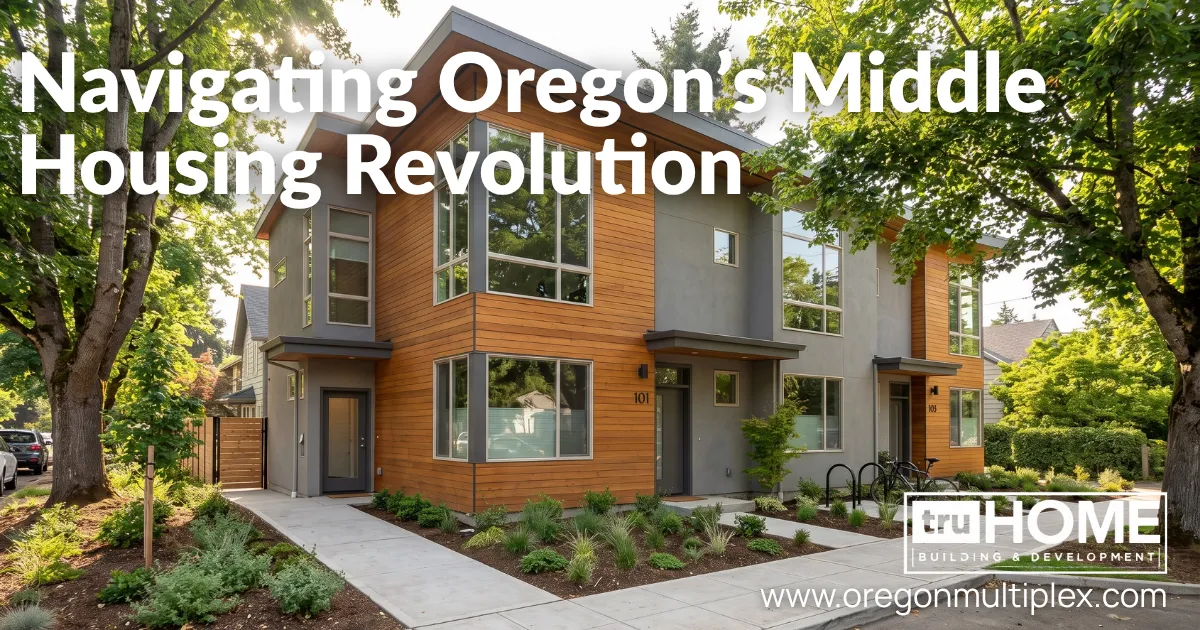
Navigating Oregon’s Middle Housing Revolution: How HB 2001 and Multiplex Development Unlock Investor Yield
For decades, traditional single-family zoning dictated urban development across Oregon. However, soaring home prices, supply shortages, and shifting demographic needs catalyzed a fundamental policy shift. Oregon’s landmark House Bill 2001 (HB 2001)—commonly known as the "Middle Housing Bill"—effectively ended exclusive single-family zoning in cities across the state.
For savvy real estate investors, HB 2001 is not merely a policy change; it represents one of the most lucrative development opportunities in modern Oregon real estate history. By permitting duplexes, triplexes, quadplexes, townhomes, and cottage clusters on lots historically restricted to single homes, investors can significantly amplify unit density, revenue potential, and long-term asset value.
What Is "Middle Housing" and Why Does It Matter?
"Missing Middle Housing" refers to multi-unit or clustered housing types compatible in scale with single-family homes. These properties bridge the gap between detached single-family houses and high-density, mid-rise apartment buildings.
Under state guidelines:
Cities with populations over 25,000 (and all jurisdictions within the Portland Metro boundary) must allow duplexes, triplexes, quadplexes, townhouses, and cottage clusters in residential areas.
Cities with populations between 10,000 and 25,000 must allow duplexes on all residential lots allowing single-family homes.
By legalizing this middle spectrum, the state created a streamlined mechanism to increase inventory without requiring massive land assemblies or high-rise urban sprawl.
The Economics of Small-Scale Multiplex Investments
Why should real estate investors pivot toward 2-to-4 unit multiplexes rather than single-family rentals or 50-unit commercial complexes?
Lower Cost per Door: Purchasing a single parcel and constructing 2 to 4 units significantly lowers land cost per door compared to building a single-family residence.
Diversified Revenue & Reduced Vacancy Risk: On a single-family rental, vacancy means a 100% loss of cash flow. In a fourplex, a single vacant unit reduces gross income by 25%, allowing the remaining three units to continue covering operating expenses and debt service.
Type I Streamlined Permitting: Under HB 2001 rules, jurisdictions must process middle housing under Type I clear and objective standards. This eliminates public hearings, arbitrary discretionary approvals, and neighborhood opposition meetings, dramatically accelerating project timelines and reducing pre-development holding costs.
Strategic Steps for Investors Capitalizing on HB 2001
To maximize return on investment (ROI) using middle housing policies:
Identify Underutilized Residential Lots: Look for older single-family homes on large, infill lots with favorable street access and utility capacity.
Analyze Utility Infrastructure Early: While zoning allows quadplexes, stormwater management and sewer connection sizes must be verified early in due diligence.
Leverage Standardized Multiplex Plans: Custom architectural designs for small infill projects can drain capital. Partnering with a specialized builder who offers optimized, repeatable multiplex footprints saves time and capital.
Final Thoughts
HB 2001 reshaped the Oregon real estate development landscape. Investors who adapt to this middle housing ecosystem can achieve superior cash-on-cash returns while providing critically needed housing across Oregon communities.
Ready to unlock the hidden equity in Oregon land? At truHOME Building and Development, we specialize in high-efficiency multiplex design, site selection, and end-to-end turn-key construction tailored for maximum investor yields. Learn how we can build your next high-performing real estate asset today at www.oregonmultiplex.com.