Build vs. Buy: The Financial Logic of New Construction in 2026
The question of whether to "Build or Buy" is no longer just about personal preference or the smell of new carpet; it’s about pure math. As we move through 2026, the real estate landscape has reached a unique inflection point. For the first time in over 50 years, the price-per-square-foot premium for new construction has dropped to a record low of roughly 10%. When you factor in builder incentives and the hidden costs of aging homes, building isn't just a luxury—it's the smarter financial play.
1. Avoiding the "Scarcity Premium"
In the 2026 resale market, inventory remains the primary bottleneck. While more sellers are entering the market, we are still 20% below "normal" pre-pandemic levels. This scarcity creates an emotional "Scarcity Premium."
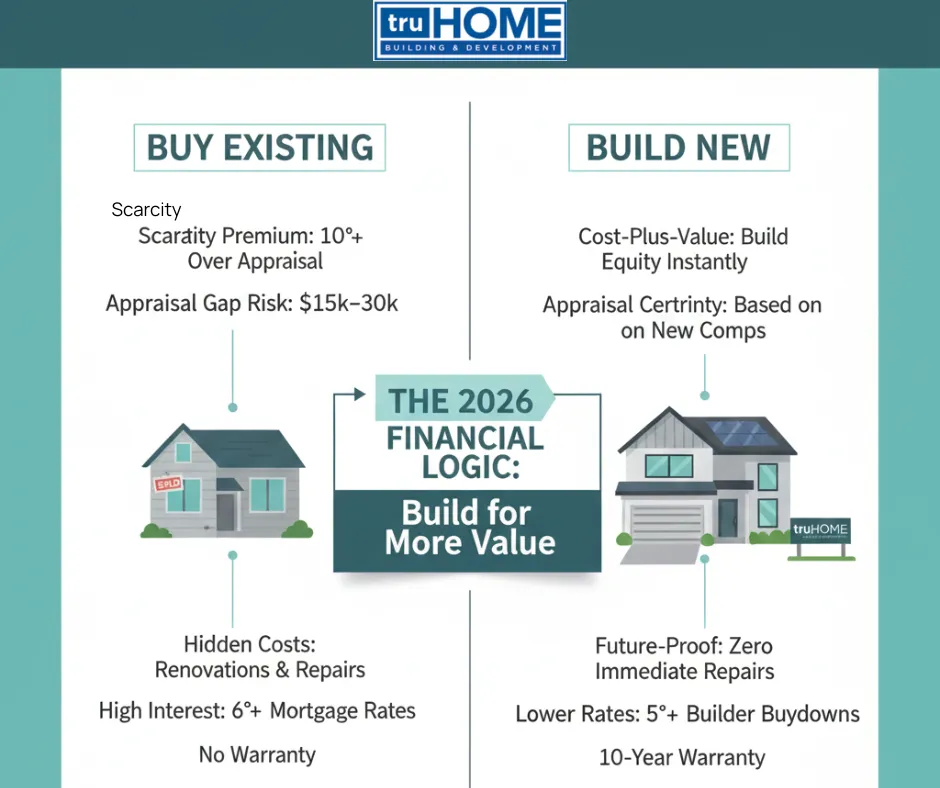
When you bid on an existing home, you aren't just paying for the house; you’re paying for the fact that three other families want it too. This often drives final sale prices 10% or more above appraised value, requiring you to bring extra cash to the table that adds zero value to the home itself.
Conversely, when you build with truHOME, you are paying for Cost-Plus-Value. You pay for the land, the labor, and materials that have finally stabilized after years of volatility. By building, you bypass the emotional bidding wars and create an asset that is worth more than the sum of its parts the moment you receive the keys.
2. The Appraisal Gap Protection
One of the most frustrating hurdles for buyers in 2026 is the "appraisal gap." Because resale volume has been historically low for three years, appraisers are struggling with a "comp problem"—there simply aren't enough recent sales to justify the high prices emotional buyers are willing to pay.
New construction offers a built-in shield against this. When you develop a new property, the appraisal is based on:
Current Replacement Cost: Reflecting today's stabilized material and labor prices.
Modern Standards: High-value "comps" are pulled from other new developments rather than 30-year-old homes with outdated systems.
Energy Performance: In 2026, "green is gold." Modern energy ratings (HERS scores) provide documented value that appraisers use to justify a higher valuation, often resulting in a stronger equity position from Day 1.
3. Builder Incentives vs. Seller Stubbornness
While individual sellers in 2026 are often "locked in" to high price expectations, professional builders and developers are motivated by volume. This has created a rare market dynamic where new homes are often more competitive than resale homes thanks to:
Mortgage Rate Buydowns: Many developers are offering to buy down rates into the 5% range, while the general market sits at 6%+.
Closing Cost Credits: It’s common to see $10,000–$20,000 in credits on new builds—cash that stays in your pocket for furniture or landscaping.
Full Warranties: You get a 10-year structural warranty that no resale seller can provide, effectively "pre-paying" for your peace of mind.
The Expert Take: Stop Competing for the Past
Buying an existing home in 2026 often means paying a 2026 price for a 1990s lifestyle. Between the "Scarcity Premium" and the inevitable "Renovation Trap," the financial logic has shifted. Building allows you to capture the development profit for yourself, ensuring your largest investment is a platform for wealth, not a drain on it.
Don't just compete for the past. Start building your future at www.oregonmultiplex.com.